
An Alternative to Toroidal Video Games
On game maps that could have been made, but apparently weren't

A little while back, I wrote an article about how many JRPGs (and video games in general) secretly take place on a torus, even when you expect it to be on a sphere.

I pointed out that there are a couple of fundamental obstructions to having a game take place on a sphere: namely, the Gauss-Bonnet theorem, and the hairy ball theorem. We noted that the former meant that any surface with a non-zero Euler characteristic had to have curvature somewhere—the sphere has a non-zero Euler characteristic, so that presents a problem. We didn’t explore this, but it is also true that the hairy ball theorem can be expanded to show that there is no non-zero vector field on any surface with non-zero Euler characteristic.
The torus, of course, has Euler characteristic zero. (I’ll write an article before too long about what the Euler characteristic is, and then we’ll actually prove this. But, for now, let’s take this as given.) Therefore, it avoids both of these obstructions, which is why we have games like Chrono Trigger and Asteroids that can make use of toroidal maps.
But is the torus the only surface with an Euler characteristic of zero? That is, was it the only available option?
No. There is one other. Let me introduce you to footage from a video game that could have been made, but never was.1
At first blush, you might look at this and think that this looks just like the JRPG maps we saw last time. (You might ask what is up with the odd-looking flying saucer. The answer is that my pixel art skills are somewhere between laughable and non-existent.) To make it easier to see what is going on, let me show you two frames from the above video: one from the very beginning, and one from about the halfway point.
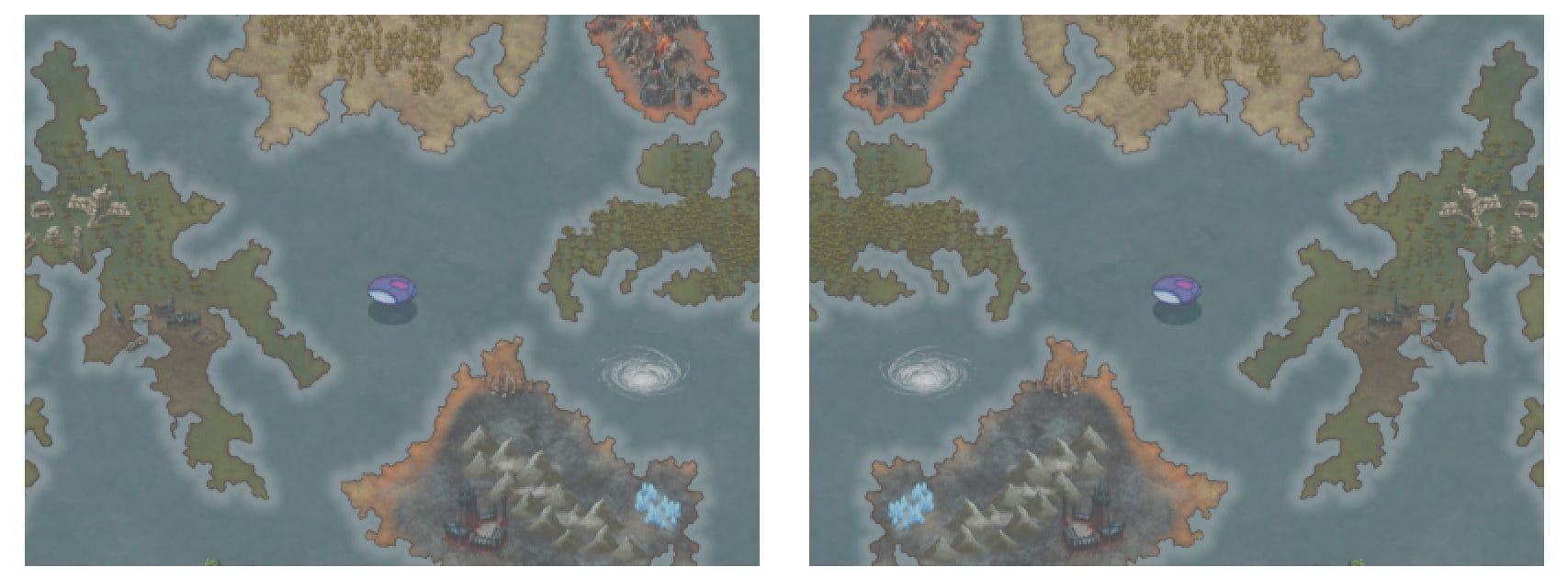
Do you see? The map is mirrored!
So that you have a better picture of what is happening, let me show you this one more time, from a different perspective: I’ll show you the entire world map, but fix it in place on the screen—instead, I’ll just move the flying saucer.
It’s now clear what is happening: if you move from left to right, this map behaves just like the torus, wrapping around. But if you move up and down, while it still wraps around, there is an additional twist. So, you can arrive back where you started, but with the opposite orientation from before! It is an example of what is called a non-orientable surface.
Now, unfortunately, the fact that it is non-orientable means that it cannot be faithfully represented in 3D Euclidean space, like the torus or the sphere can. But we can cheat a little and come up with a representation that is almost faithful—it will have some self-intersection that isn’t characteristic of the original surface, but if you ignore that, it’s essentially correct.
We obtain this representation by taking the map and gluing opposing edges. But while the first pair is straightforward (and is exactly like the analogous gluing for the torus), the second pair is trickier, because of the twist that wasn’t present before. We can’t simply glue opposite ends together the way we did previously—we need to angle them carefully so that they line up correctly. This can be done by passing the surface through itself.
Let me show the end product again, but made transparent so that you can see what is happening on the inside.
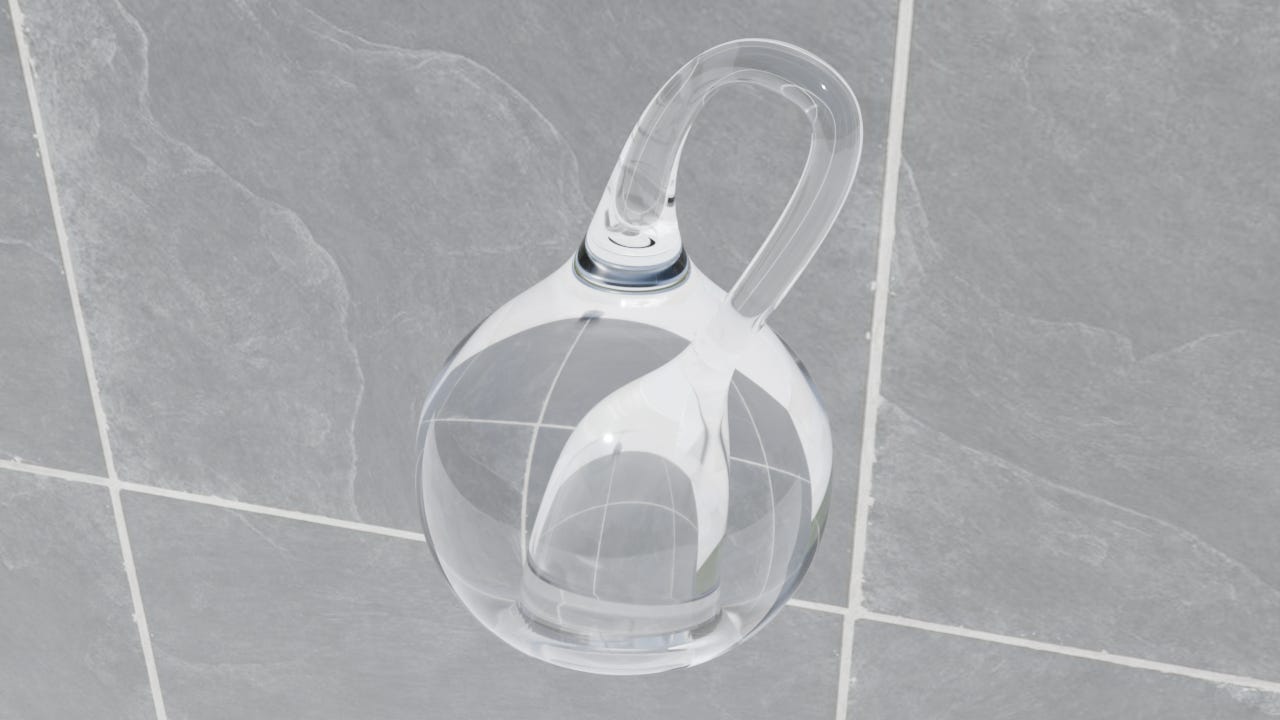
This is what is commonly called a Klein bottle, named after Felix Klein, who originally described it in 1882. I cannot say for certain, but I doubt that he considered its utility in video gaming.
We have finally arrived, in a slightly roundabout way, at what I actually wanted to talk about. You see, I have a beef with many attempted popularizations of mathematics, and the Klein bottle is a prime example.
When the Klein bottle is normally described to laypeople, it is usually via something like the last illustration that I provided—usually with some hurried clarifications that the Klein bottle doesn’t really intersect itself—it’s just that it isn’t possible to represent accurately in 3D space, and this is the closest we can get to drawing it. If it is not this, then instead it is usually something like “the Klein bottle is what you get by gluing two Möbius strips together.”
This isn’t wrong, but I maintain that we do a great disservice to our readers with such descriptions. They are hard to visualize, invite themselves to misunderstandings2, provide no sense that they are significant or discoverable, and don’t even give an accurate representation of how mathematicians actually work and think about such objects! If you want do that, forget about the bottle (pretty as it might be), and instead draw a diagram like the following.
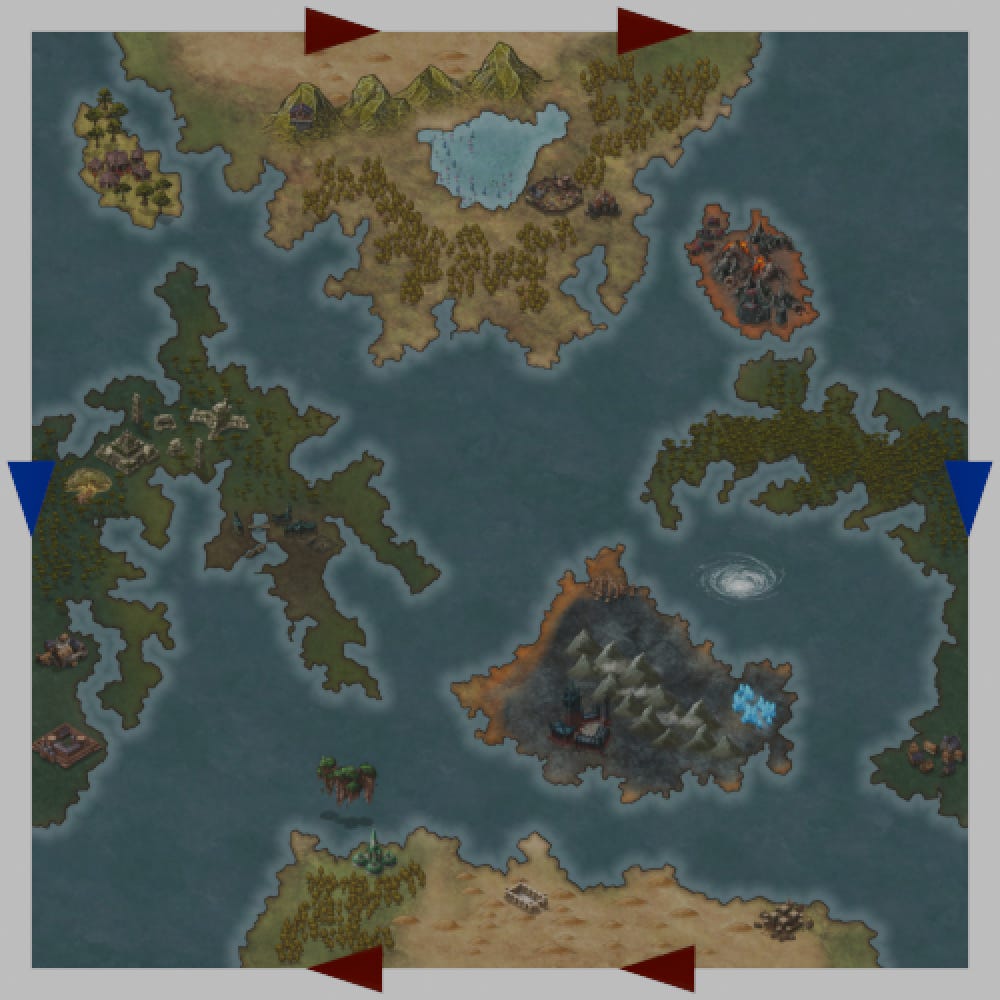
The arrows tell us how to glue opposite sides together: from left to right, it is the same straightforward taping that we saw when studying the torus; from top to bottom, there is an additional twist.
This representation is vastly easier to work with. If you want to picture the trajectory of an object moving in a straight line on the Klein bottle, it is very easy to draw with this representation, and excruciatingly difficult with the “bottle” picture. If you want to animate an object traveling around the Klein bottle, this representation makes that quite simple—trying to do it on the “bottle” would be an absolute nightmare!
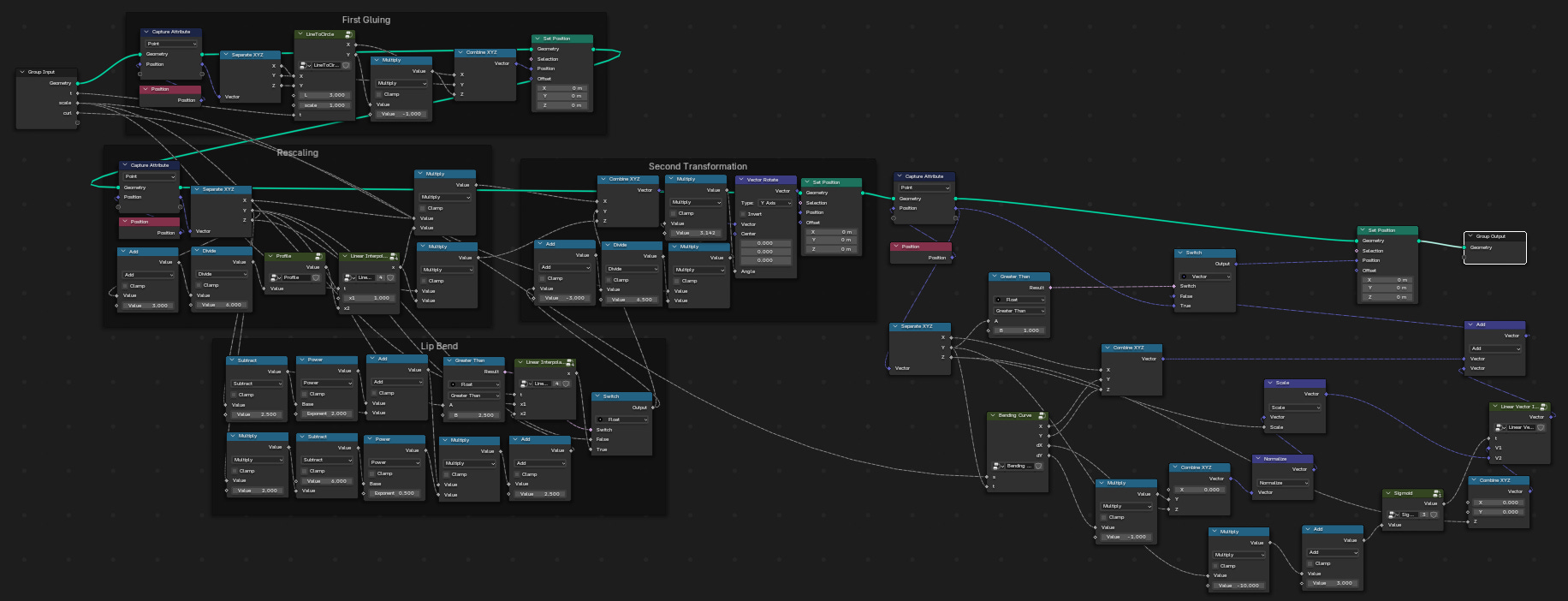
If you are curious about how I made this: the original map was made in Inkarnate, where I originally made an account for D&D purposes. The saucer I made by hand on pixilart.com. I combined everything together and animated it in Blender, adding some post-processing filters to get the right pixellated look.
A common one is to ask about pouring anything into a Klein bottle—it doesn’t make sense, since the Klein bottle isn’t a surface in 3D space with a defined inside or outside.
Now I want to see a game played on a Klein bottle.
To do the concept justice, you would need to make orientation meaningful. Perhaps something like a puzzle-platformer where your character has asymmetric abilities, so that you have to return to the same location in the opposite orientation to make progress.
So wait, what goes wrong if you try to do a projective plane instead by twisting both axes? Apparently something must, but I can't offhand think of what!