
When are Two Groups the Same Group?
The fourth lecture on group theory

Last time, we looked at a couple of special kinds of subgroups: matrix groups and cyclic groups. We recognized that the latter seems to be entirely characterized by the order of the generator.

However, we lacked the language to express that the groups are, in some sense, “the same.” Our goal for today is to figure out how to express that idea.
Before we get into it, let’s look at two more examples in more depth. Consider the cyclic subgroup of ℂ× generated by i. Let’s write out its Cayley table.
This is just the multiplication table of a group: each of the rows and columns is labeled by an element of the group, and the corresponding cell is the product of the two—specifically, the row label times the column label, since group multiplication is not always commutative.
Now, consider the cyclic subgroup of GL(2, ℝ) generated by
Its Cayley table looks like this.
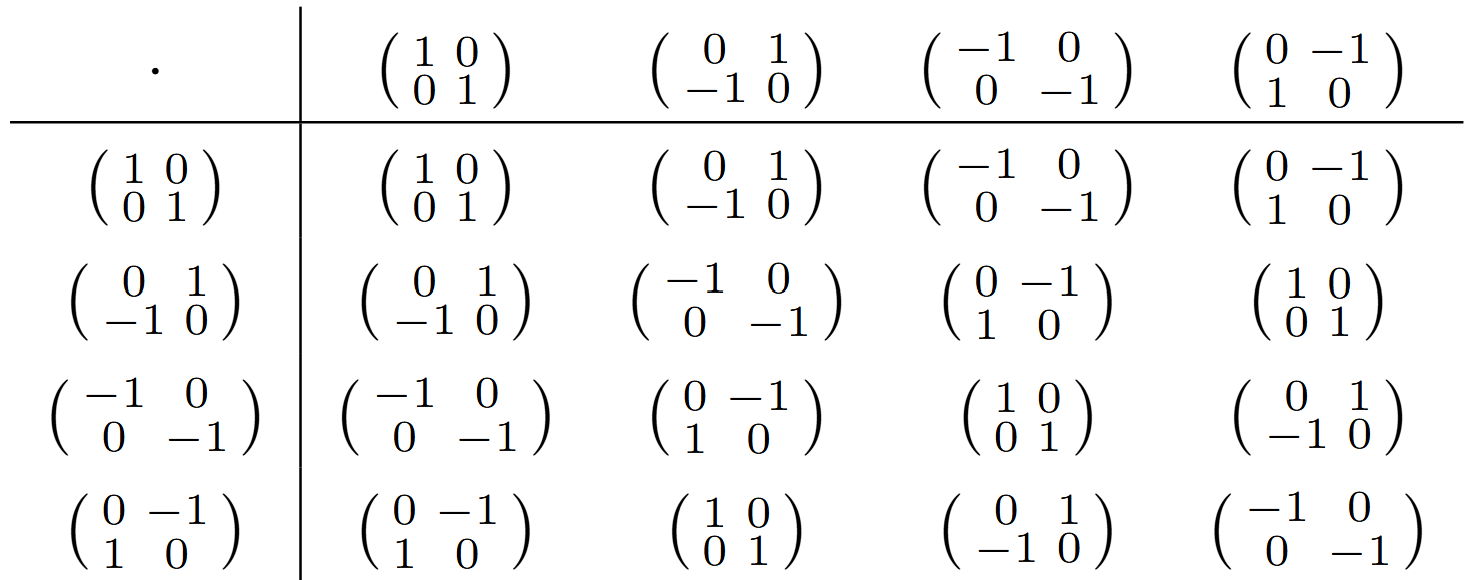
If you compare these two Cayley tables, you’ll realize that both of them are actually of the following form.
In other words, they have the same Cayley table, once you recognize that we need to match
So, we need a bijection between these two groups, and we need this bijection to preserve the Cayley tables, in the sense that if you use it to substitute out all of the elements, you still get a valid Cayley table. This leads us to the following definition.
Definition: A (group) isomorphism between two groups G, H with operations × and ⋅, respectively, is a bijection φ: G→H such that φ(g×h)=φ(g)⋅φ(h) for all g, h in G.
The intuitive idea of the isomorphism is that it is a process of renaming: it allows us to relate two groups that look different but are essentially the same up to relabeling the elements. And this gets at a core philosophical point: we do not care how things look. We care about what they do.
Now, why does this definition actually capture this idea? Well, think about what we said before about preserving Cayley tables. In the Cayley table of G, if g and h are a row and a column, then the corresponding entry would be g×h. This needs to be mirrored in H. So, our relabeling function φ changes the row to φ(g) and the column to φ(h). It will also change the corresponding entry to φ(g×h). For this to be a valid Cayley table, we need this to be the same as… φ(g)⋅φ(h). Ah ha! Hence the definition.
“But wait!” you might protest. “We made sure that the Cayley table of H reflects the Cayley table of G. But how can we be sure that it goes the other way: that the Cayley table of G reflects the Cayley table of H? Maybe we should also request that φ-1(g⋅h)=φ-1(g)×φ-1(h) for all g, h in H?”
An excellent suggestion, but unnecessary, due to the following result.
Theorem: If φ: G→H is a group homomorphism, then so is φ-1: H→G.
Proof: Choose any g, h in H. We need to prove that φ-1(g⋅h)=φ-1(g)×φ-1(h). Observe that since φ is bijective, if we prove that φ(φ-1(g⋅h))=φ-1(g⋅h)=φ(φ-1(g)×φ-1(h)), then our desired result will follow. But the left-hand side is just g⋅h, and the right-hand side is
where we used the defining property of the isomorphism in the middle. □
If there exists an isomorphism between G and H, we shall say that they are isomorphic, and write G≅H. The above theorem then says that if G≅H, then H≅G, which is to say that isomorphism is reflexive. Those who are familiar with equivalence relations might therefore be unsurprised by the following result.
Theorem: Isomorphism is an equivalence relation. That is, for any groups G, H, K:
G≅G;
if G≅H, then H≅G; and
if G≅H, and H≅K, then G≅K.
Proof: The first statement is clear from the fact that for any group G, the identity function x↦x is an isomorphism of G with itself. The second statement we already proved. As for the last one, if we have two group isomorphisms φ: G→H and ψ: H→K, then we can compose them together into a bijection ψ∘φ. Is this a group isomorphism? Observe that
(Here, we used the common convention of writing gh instead of g⋅h when it is clear what the multiplication is from context.) □
Let’s look at a couple of examples before we move forward.
The map
is an isomorphism between the two cyclic subgroups that we considered earlier. Checking this amounts to checking the Cayley tables.
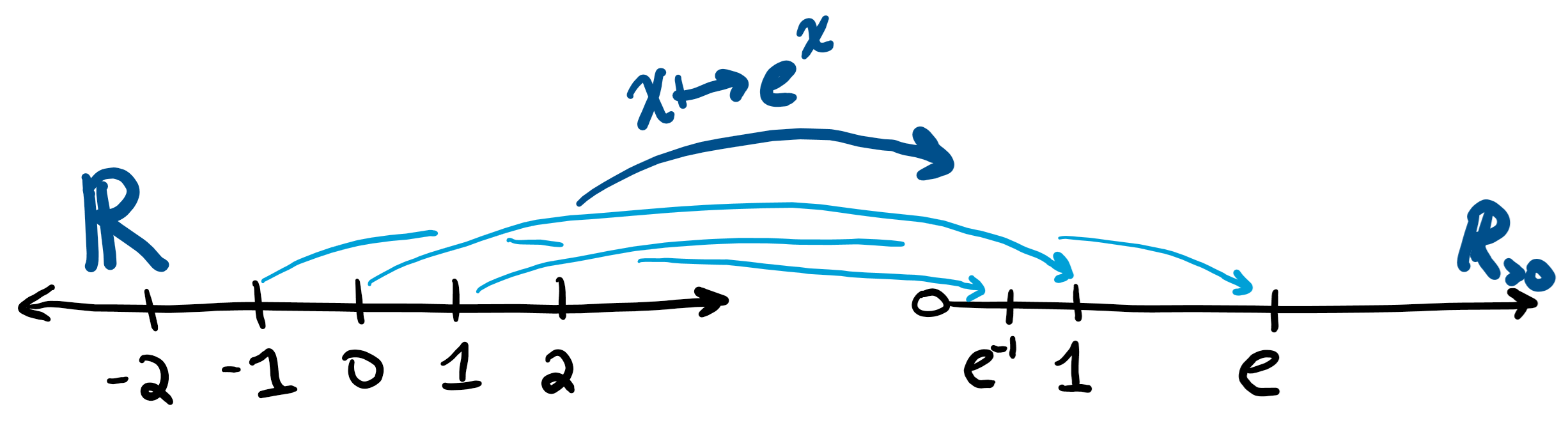
The exponential function x↦ex is an isomorphism between ℝ, considered as a group under addition, and ℝ>0 (the set of positive real numbers), considered as a group under multiplication. Indeed, ex+y=exey is nothing more than the defining property of an isomorphism.
The map
is a group isomorphism, where we are looking at a cyclic subgroup of GL(2, ℝ) on the right.
