
Where are Groups? What are Groups? Why are Groups?
A first lecture on the subject

By popular demand, I am doing a longer series of posts on group theory—this is the first in the series. It is loosely based on my lecture notes from when I taught abstract algebra.
I explained in an earlier article how a little knowledge of group theory can be useful for building networks such as those in a supercomputer. And I gave a definition of a group that I described as “rough and ready.”

This first lecture is intended to give the bigger picture: we’ll give a better definition of what a group is (and we’ll discuss why it is better), we’ll discuss where this definition came from, and we’ll preview various places in mathematics and elsewhere where groups appear.
Let’s start.
Definition: A group is a set of elements G, equipped with a binary operation • : G×G→G such that
• is associative—that is, for all x, y, z in G, x•(y•z)=(x•y)•z;
there exists an identity—that is, there exists some element, which we shall (most often) denote by 1, such that x•1=1•x=x for all x in G; and
every element has an inverse—that is, for every x in G, there exists an element, which we shall (most often) denote by x-1, such that x•x-1=x-1•x=1.
There are various objections that the reader might raise at this point, such as:
This feels very abstract. Is that really needed?
You talk about an identity and an inverse, but you write them as if they are unique elements. Isn’t there some ambiguity?
This looks very different from the definition in your earlier article. Were you lying then about what groups are, or are you lying now?
I answer:
The abstraction yields generality: it allows groups to show up in a multitude of different contexts, and yet we can prove theorems about all of them—that is very powerful!
While we initially say that there is an identity and an inverse for every element, it is very simple to prove that they are unique. Thus, there’s no ambiguity. Let’s save this for the second lecture, however, and just take it as given for now.
Neither! If you look carefully, it isn’t too hard to see that groups as I defined them last time are examples of groups as I defined them this time. But it also goes the other way: any group can be given a (possibly infinite) presentation, which returns us to the definition of the earlier article. Thus, they are equivalent, but the new definition is much more convenient (and doesn’t suffer from arbitrary choices). Once again, let’s save this for a later lecture.
Instead, let’s start by giving many examples (and non-examples) of groups, so that they start feeling a little more concrete.
The set of integers, with addition as the operation, is a group. (0 is the identity; -x is the inverse of x.)

The set of natural numbers, with addition as the operation, is not a group. (0 is the only natural with an inverse.)
The set of positive real numbers, with multiplication as the operation, is a group. (1 is the identity; x-1 is the inverse of x.)
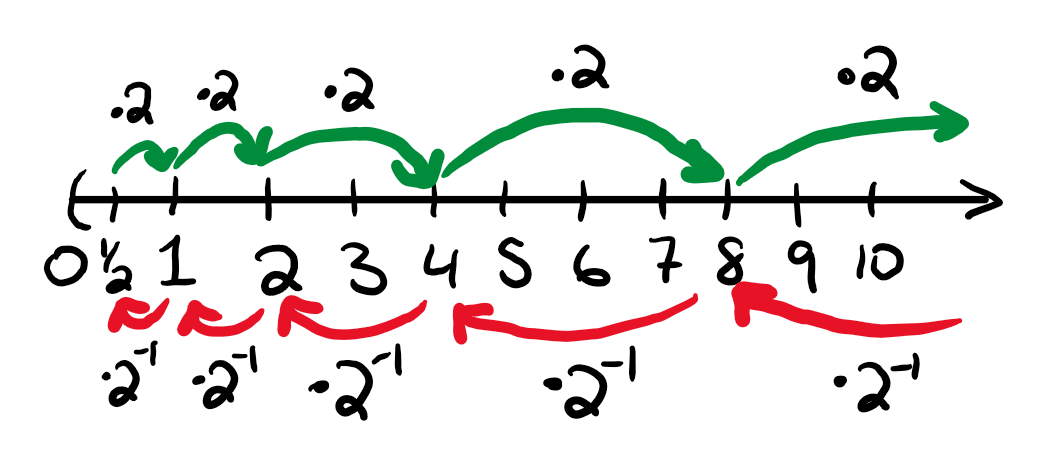
The set of real numbers, with multiplication as the operation, is not a group. (0 lacks an inverse.)
The set of rotations of Euclidean 2D space around the origin, with composition as the operation, is a group. (A rotation of 0 radians is the identity; a rotation by -x radians is the inverse of a rotation by x radians.)
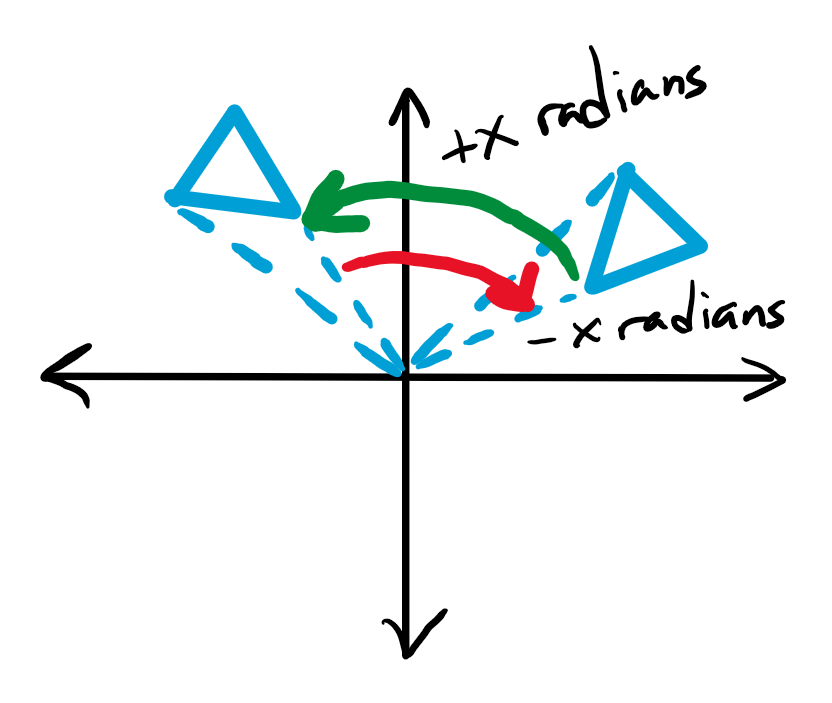
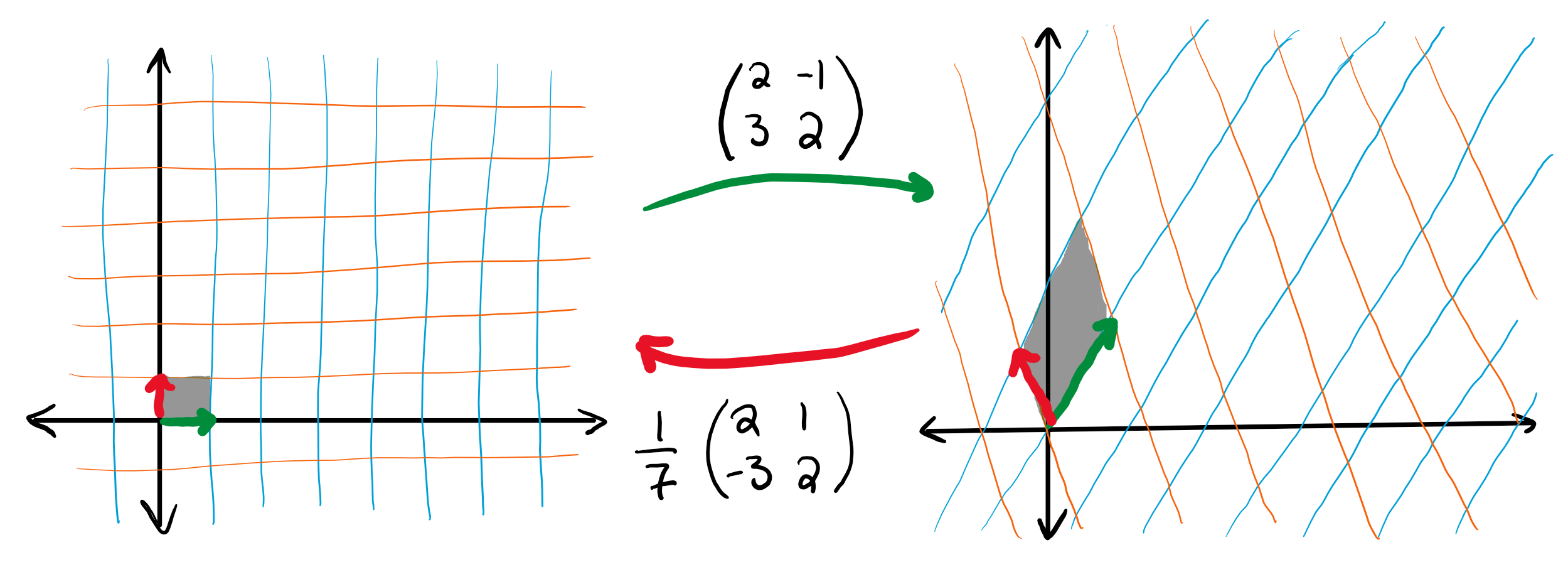
The set of all rotations of Euclidean 3D space around the origin, with composition as the operation, is a group. (This takes a little thought: you need to prove that the composition of two rotations is a rotation. Some knowledge of linear algebra is very helpful.)
The set of all n×n real matrices with non-zero determinant, with matrix multiplication as the operation, is a group. (The identity matrix is the identity; inverse matrices exist precisely when the determinant is non-zero.)
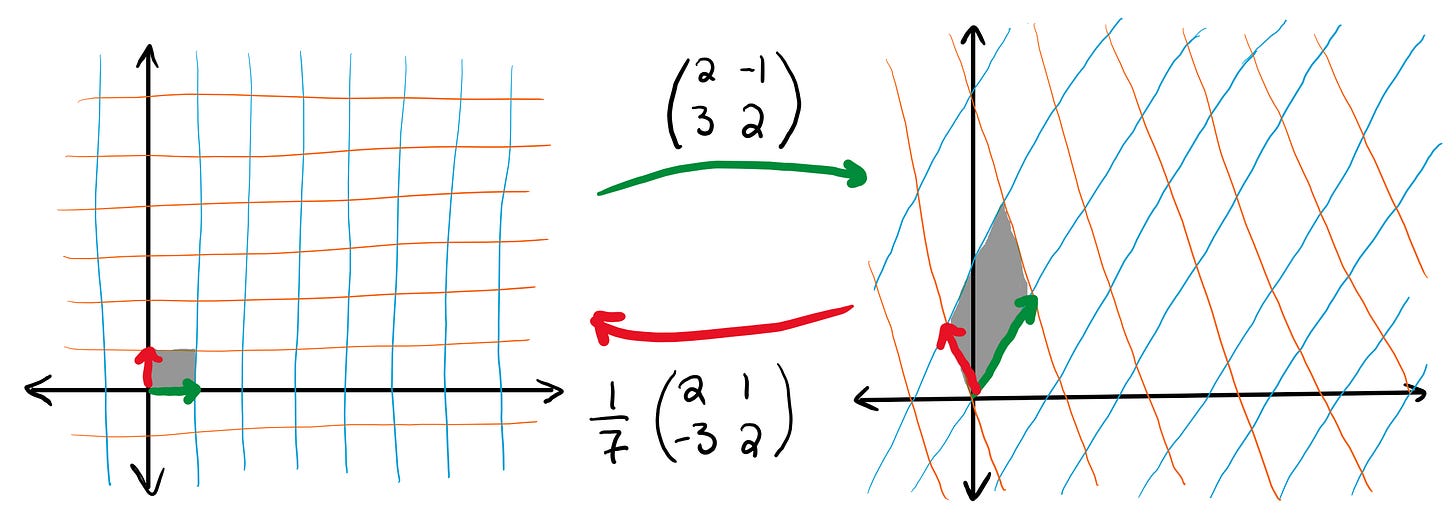
Consider the set {Rock, Paper, Scissors, Tie}. Define an operation as follows: if x, y are both legal moves of Rock-Paper-Scissors, then x•y=y•x=the winning move (e.g. Rock•Paper=Paper) or Tie if it is a tie; otherwise, use Tie•x=x•Tie=x. This is not a group. (Although Tie is an identity and every element is its own inverse, the reader should check that the operation is not associative!)
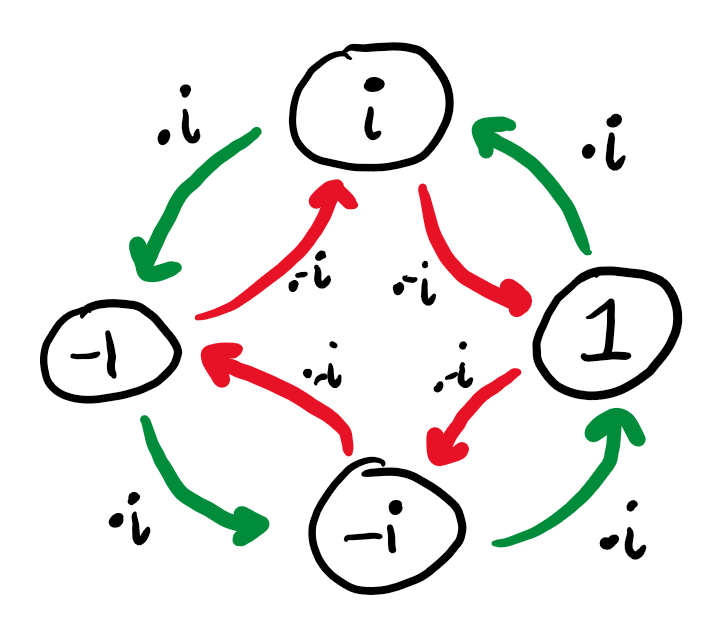
Consider the set {1,i,-1,-i} with multiplication as the operation. This is a group. (1 is the identity; I leave it to the reader to work out the inverses.)
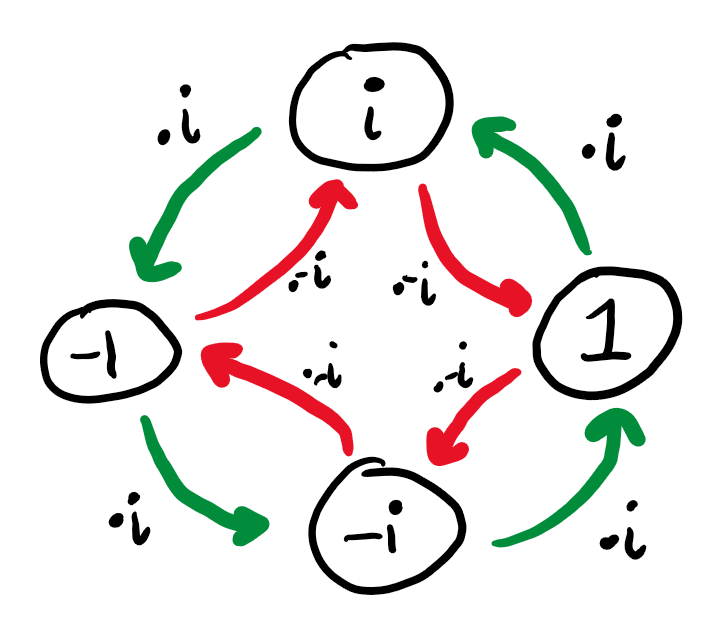

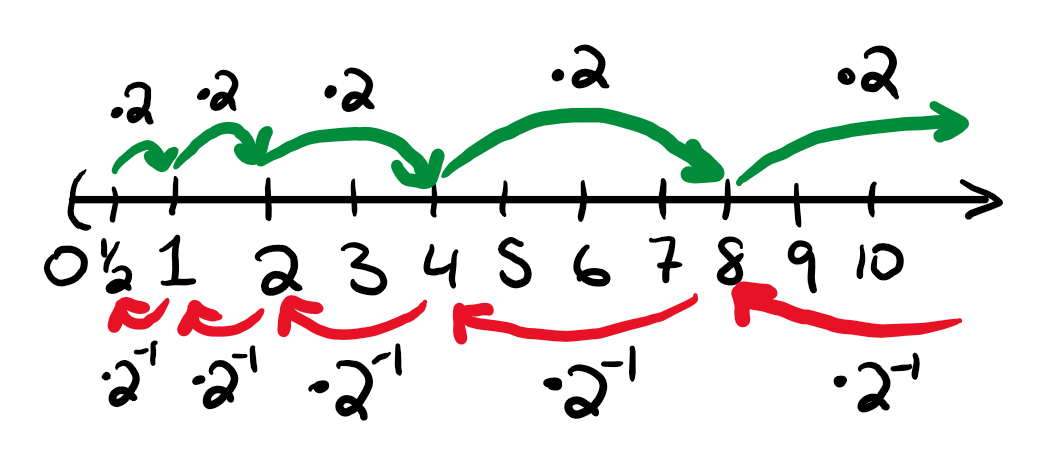
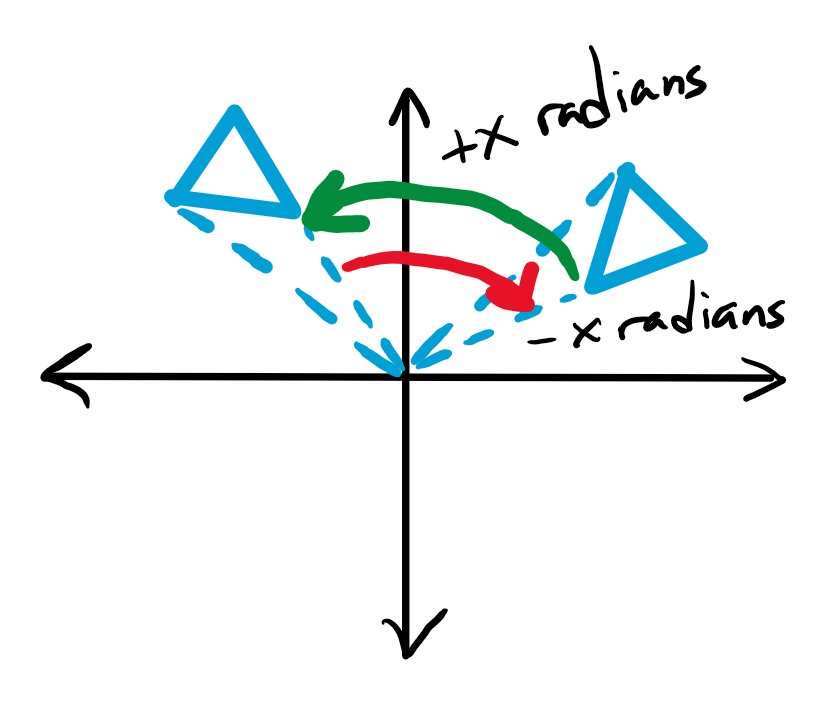
That’s enough for now; we’ll see plenty more later. Observe that:
Groups appear in all sorts of places: we can already see them in arithmetic, geometry, and linear algebra.
Groups can look like anything at all: numbers, functions, matrices, etc.
Groups can be commutative, but don’t have to be. (Composition of 3D rotations is not commutative; neither is matrix multiplication.)
Groups can be infinite, but don’t have to be.
I’ll repeat this again: the flexibility of groups is a powerful asset.
Of course, at this point, you might well wonder why this is the right definition for us to study. For instance, why is associativity so important; maybe we could study commutativity instead, and that would be at least as interesting? (E.g., Rock-Paper-Scissors would qualify.)
There’s a historical answer to this and what I consider to be the “true” answer. Since the “true” answer requires knowing a little about group actions, let’s content ourselves with the historical answer for now—we’ll come back to the “true” answer in a later lecture.
Groups arose essentially independently in at least four different contexts in the 18th-19th centuries:
Permutation groups: Lagrange initiated the study of ways to shuffle around elements, and proved some results that we now interpret as being part of group theory. This was developed further, coming to a head with Galois using it to prove that there are polynomials whose roots cannot be expressed in terms of radicals; he also coined the term “groups”, although he thought of them only as collections of permutations.
Modular arithmetic: The modern approach to it was laid out by Gauss in 1801; you can think of it as “arithmetic on a clock”. Of course, there are various results that we now think of in terms of modular arithmetic that are much older (e.g., Fermat’s little theorem). In any case, the study of addition and multiplication in modular arithmetic is almost synonymous with the study of finite abelian groups.
Class groups: Gauss originated the study, but it was Dedekind who gave the modern conception in the 1870s. Essentially, the class group measures how far an algebraic structure like the integers is from having unique prime factorization.
Geometry: In the 1870s, Klein had the bright idea that one could study and classify geometries based on the kinds of isometries that the geometry permits. But the collection of isometries of a space is—you guessed it—a group.
In the 1880s, mathematicians finally realized that they were seeing the same concept over and over in different contexts, and proceeded to unify it. Group theory was born.
Since then, group theory has wormed its way into countless different contexts and applications. Here is a highly abridged list:
Galois groups are fundamental objects of Galois theory. Galois theory can be sort of summed up (although it is an oversimplification) as the study of how roots of polynomials can be shuffled around while maintaining algebraic relationships. We already noted that Galois groups can be used to produce polynomials whose roots are not expressible in terms of radicals. Using similar ideas, you can prove various impossibility results in geometry, such as the fact that you cannot trisect an angle using a straightedge and compass.
Lie groups are groups that are “smooth”—i.e. groups that you can also think of as surfaces. These show up in the study of partial differential equations; this is because if you can show that solutions to your partial differential equations satisfy some type of symmetry, this can significantly decrease the difficulty of solving the equation. Of course, Lie groups precisely capture such symmetries. This is such a fundamental relationship that it has become a cornerstone of modern quantum field theory.
Differential Galois theory is analogous to ordinary Galois theory, but studies differential operators. Groups are also fundamental here, although they tend to be matrix Lie groups, rather than finite groups. Differential Galois theory allows one to study how and when some functions are derivatives of other functions. If you have ever wondered how computer algebra systems are able to take a function and automatically compute its integral (or tell you that no elementary antiderivative exists), the secret is the Risch algorithm, which is built up using ideas of differential Galois theory.
Following Klein, groups allow you to study and quantify the symmetries of a space. This has applications, from the silly to the deeply useful.
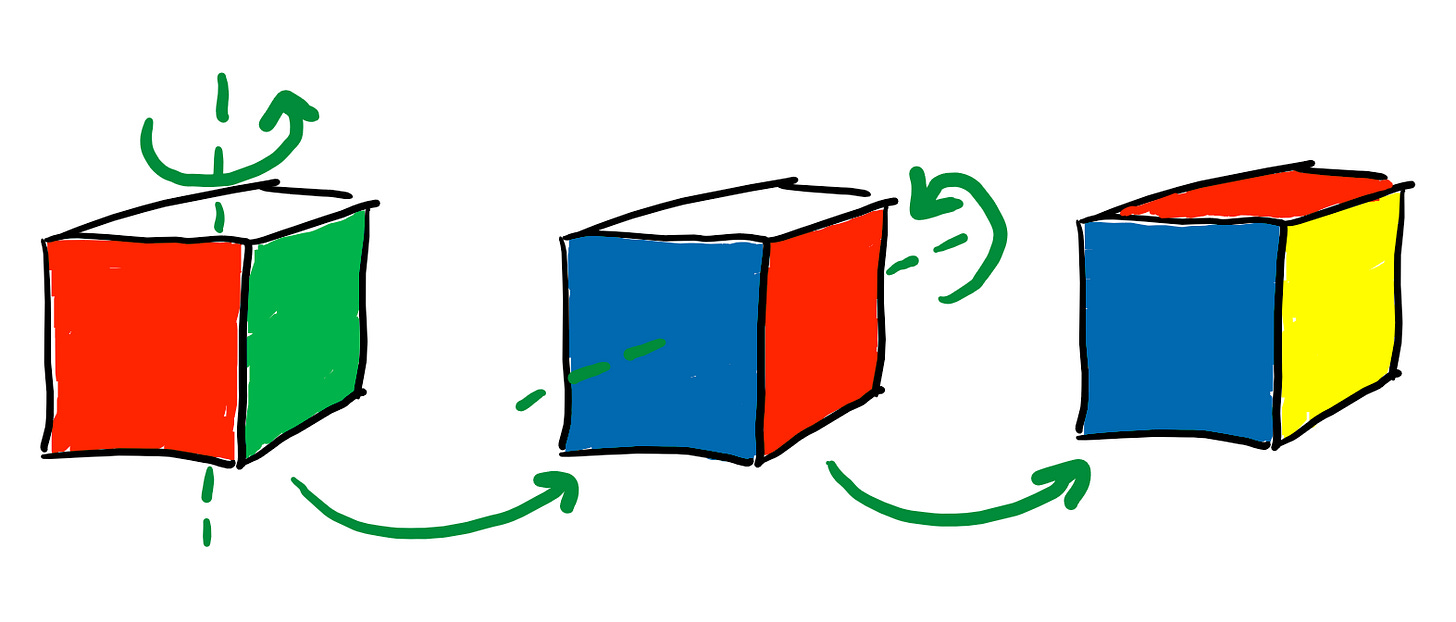
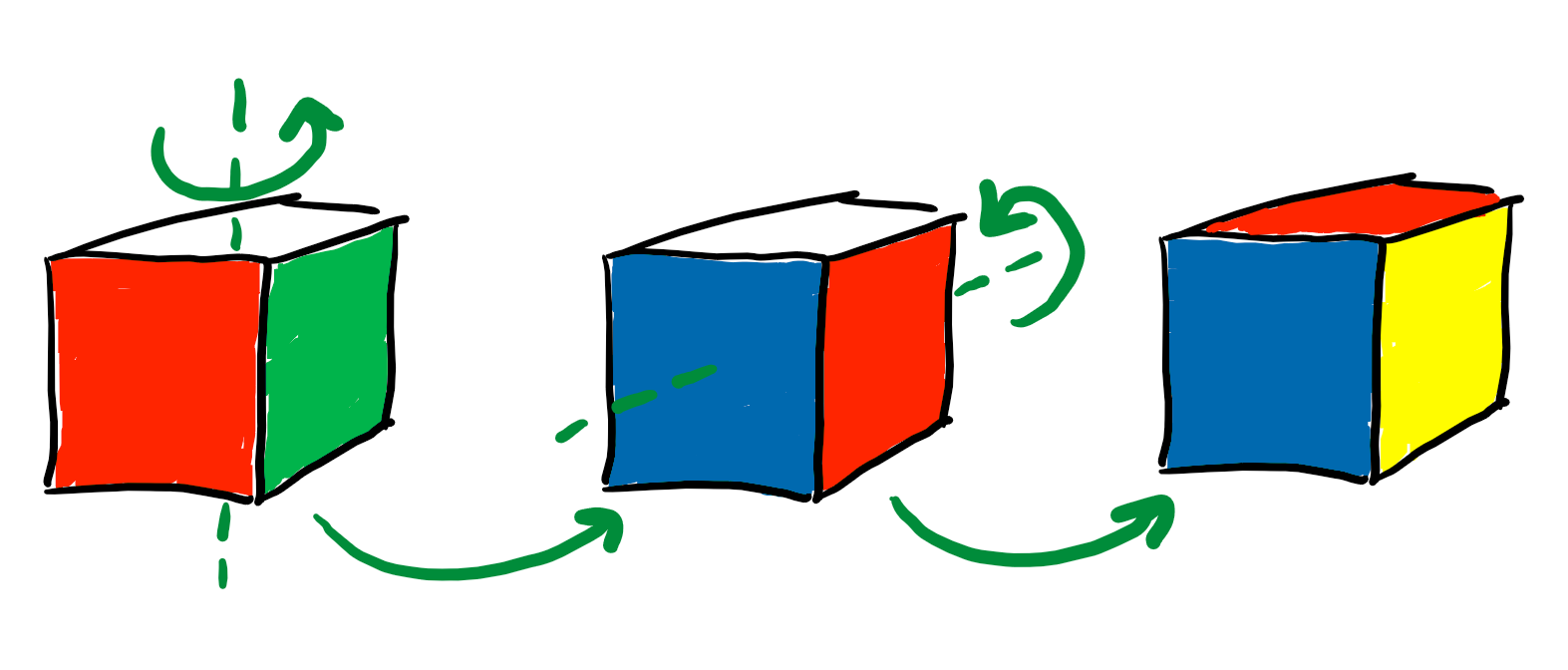
All of the different ways that you can move a Rubik’s Cube form a group. If you understand the generators and the relations between them, you can build algorithms allowing you to solve a Rubik’s Cube.
In chemistry, the symmetries of crystal lattices are studied and described in terms of group theory.
It is common to consider hyperbolic geometry primarily through the lens of its isometry group, because the expressions for distance are usually pretty ugly.
As we said above, the study of finite abelian groups develops alongside elementary number theory, and there are many results in one that prove results in the other (and vice versa). But these are fundamental building blocks in various cryptographic protocols, such as the Diffie–Hellman key exchange and RSA. Cryptographic protocols that are not based on this are often instead based on elliptic curves, but those have their own vitally important group structure.
Fundamental groups are basic objects in algebraic topology, as are homology and cohomology groups, for that matter. All of these different objects let you prove all sorts of nice topological things, and allow you to show that various surfaces and spaces are different topologically (e.g., you cannot deform one into the other).
Observe that in all of these examples, commutativity is comparatively rare, but associativity is essentially universal.1 In some sense, this justifies the definition of a group being what it is.
Next time, we’ll prove some basic theorems about groups (e.g., the uniqueness of the identity) and start considering subgroups.
Someone will no doubt point out that Lie groups are usually studied using Lie algebras, and the Lie bracket on the Lie algebra is not an associative operation. This is very true, but I would like to point out that any Lie algebra is a sub-algebra of some ring, with the bracket then simply given by [x,y]=xy-yx. That is, it is a combination of associative operations!
Does the requirement that the group be a set (as opposed to a proper class) have a meaningful role in this early discussion? The set requirement seems to impact studies of equivalence classes of group elements under the orbits imposed by a subgroup, which is one of the principle tools in the classification of groups.
I've given exams solving problems in groups rings and fields in high-school. But nobody not even the teachers explained what these structures have to do with solving algebraic equations. I found out later that it has to do with symmetry. But how ? Everybody drop the words symmetry of solutions and that's it , they don't do deeper. What has the symmetry of solutions in a descartian reference system to do with solubility of the equation? Maybe you'll write a detail article. I'll follow your substack.