
How Is a Fish Like a Number?
Where Linnaean taxonomy runs into issues

I have been asked many times, “What is a number?” (e.g. here, or here). Before I give my take on this question, let me ask a seemingly unrelated one:
“What is a fish?”
Webster’s 1828 dictionary defined fish as follows:
An animal that lives in water. fish is a general name for a class of animals subsisting in water, which were distributed by Linne into six orders. They breathe by means of gills, swim by the aid of fins, and are oviparous. Some of them have the skeleton bony, and others cartilaginous. Most of the former have the opening of the gills closed by a peculiar covering, called the gill-lid; many of the latter have no gill-lid, and are hence said to breathe through apertures. Cetaceous animals, as the whale and dolphin, are, in popular language, called fishes, and have been so classed by some naturalists; but they breathe by lungs, and are viviparous, like quadrupeds. The term fish has been also extended to other aquatic animals, such as shell-fish, lobsters, etc. We use fish in the singular, for fishes in general or the whole race.
This agrees with how the term fish was used historically: it included animals like whales as fish. Indeed, etymologically, the word “whale” means “large sea fish.” Europeans as a whole seemed to have a very hazy idea of what a whale is, often drawing them (incorrectly) with scales.

In 1735, Carl Linnaeus published Systema Naturae, which was intended to catalog the various types of animals and plants in nature, and to give a consistent way to categorize them in what is now known as Linnean classification. The overall idea was to split everything into coarse groups (Linneus used animals, plants, and minerals), then each into subgroups, and those into subgroups, and so on, based on shared characteristics.
In the 1st edition, whales were classified as fish. But in the 10th edition—largely considered to be the starting point of modern zoological classification—they were reclassified as mammals, a position that they have held ever since.
Modern Linnean classification uses the same idea of hierarchical categories, but it is informed not by shared characteristics, but by shared common ancestors: the more recent the last common ancestor is, the closer two species are in the classification, which naturally takes the form of a tree as a consequence. For instance, here is part of this tree for vertebrates (the sub-phylum Vertebrata).
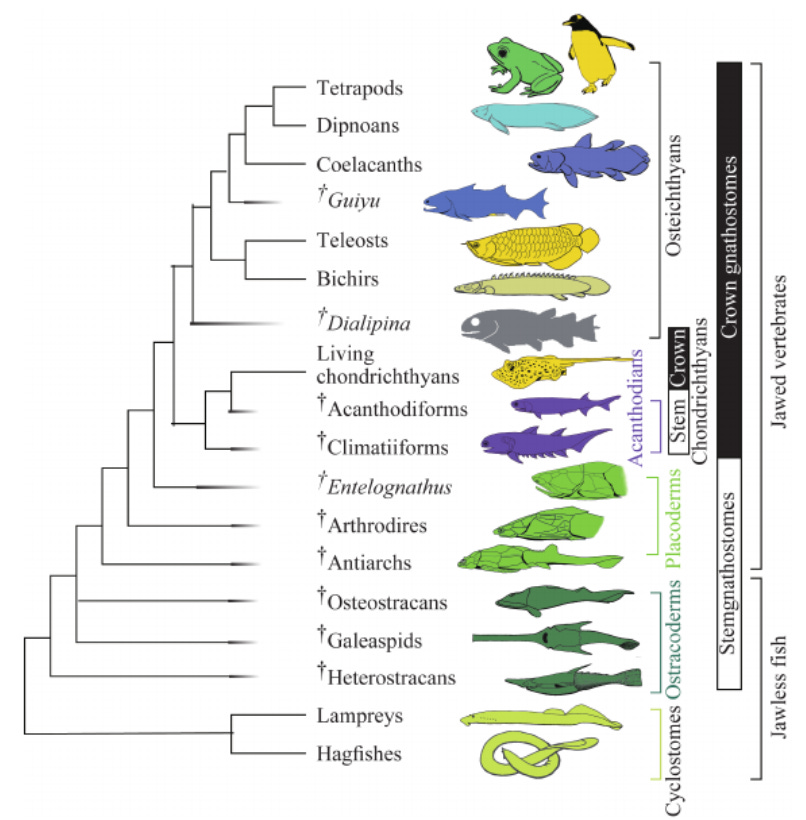
You might notice something a little funny with this diagram: it appears to entirely consist of fish… with the exception of the tetrapods. Tetrapods include all reptiles, amphibians, mammals, birds, and a whole host of extinct land animals. And this finally brings us back to the modern scientific definition of a fish (to the extent that there is such a thing), which is that a fish is any vertebrate that is not a tetrapod.
Notice that this goes entirely against the whole idea of modern taxonomy, which is that species should be grouped together if they have the same common ancestors! Coelacanths have much more in common with us humans than they do with hagfish, and yet coelacanths and hagfish are both types of fish, but we are not.
It is evident, then, that if “fish” were defined sensibly, then whales, humans, birds, and so on should be classified as such. To quote Moyle and Cech’s Fishes: An Introduction to Ichthyology, “humans are not the pinnacle of evolutionary progress but only an aberrant side branch of fish evolution.”
Or, alternatively, we should accept that the term “fish” has no scientific definition.
What does any of this have to do with numbers? I claim that just as the term “fish” has no sensible scientific definition, the term “number” doesn’t have a sensible mathematical definition.
Dictionary definitions of the word are typically quite bad. The same Webster’s 1828 dictionary gives the following:
In mathematics, number is variously distinguished. cardinal numbers are those which express the amount of units; as 1.2.3.4.5.6.7.8.9.10. Ordinal numbers are those which express order; as first, second, third, fourth, etc.
Determinate number is that referred to a given unit, as a ternary or three; an indeterminate number is referred to unity in general, and called quantity.
Homogeneal numbers, are those referred to the same units; those referred to different units are termed heterogeneal.
Whole numbers, are called integers.
A rational number is one commensurable with unity. A number incommensurable with unity, is termed irrational or surd.
There are various problems with this, such as the fact that this definition clearly does not count complex numbers as numbers. This is not Webster’s fault—mathematicians were only just starting to become comfortable with their use around this time, and he could not be expected to be in tune with the state-of-the-art development. However, modern texts don’t seem to do much better—for example, Wikipedia states that
A number is a mathematical object used to count, measure, and label.
I don’t know how to count or measure using complex numbers1. On the other hand, literally anything can be used as a label. Is US President James Garfield secretly a number? The modern online Webster dictionary gives many definitions, but the most pertinent seem to be these:
(1): a unit belonging to an abstract mathematical system and subject to specified laws of succession, addition, and multiplication
(2): an element (such as π) of any of many mathematical systems obtained by extension of or analogy with the natural number system
There are laws for adding and multiplying complex numbers, but there is no law of succession: given a complex number, there is no such thing as the “next” one; thus, the first definition clearly doesn’t suit. The second does suit, but it states in a delightfully vague way that it is a member of “any of many [emphasis added] mathematical systems.” Which ones?
One might very reasonably think that mathematicians would have a neat classification. And one would be entirely wrong. There is, instead, a weird zoo of entities that get called numbers, with no real overarching idea of what unifies all of them.
Modern mathematics, much like modern biology, has a reasonably sensible way of classifying mathematical systems based on their algebraic properties. In analogy to the Linnean classification2, you might see a diagram like the following.
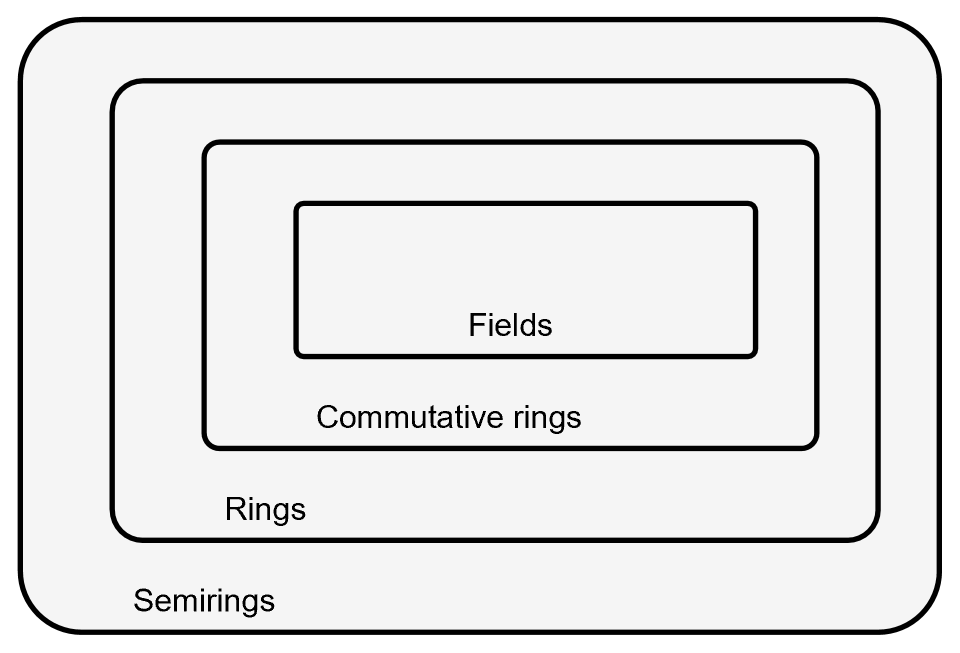
All of these are types of algebraic structures with an addition operation (usually written as +), a multiplication operation (usually written as •), and two special elements (usually written as 0 and 1). Each is characterized by the properties that we ask them to have. For example, in a semiring, we ask that
+ is associative—that is, a+(b+c)=(a+b)+c;
+ is commutative—that is, a+b=b+a;
• is associative—that a•(b•c)=(a•b)•c;
0 is the additive identity—that is, a+0=0+a=a;
1 is the multiplicative identity—that is, a•1=1•a=a; and
• distributes over addition—that is, a•(b+c)=a•b+a•c and (a+b)•c=a•c+b•c.
a•0=0•a=0.
A ring is a semiring, but we also require that there are additive inverses—for every a, there exists some b (usually written as -a) such that a+b=b+a=0.
A commutative ring is a ring, but we also require that • is commutative—that is, a•b=b•a.
Finally, a field is a commutative ring in which 1≠0 and there are multiplicative inverses—that is, for every a≠0, there exists b (usually written as a-1) such that a•b=b•a=1.
Let’s consider some examples. The natural numbers (0, 1, 2, …) are a semiring—they are not a ring, because they don’t have additive inverses. The integers are a ring because they do—moreover, they are a commutative ring, because the multiplication is commutative. But they are not a field, because they don’t have multiplicative inverses.
The rational numbers, the real numbers, and the complex numbers are all fields.
The collection of all 2×2 real matrices is a ring (the identity matrix takes the place of 1, and the zero matrix takes the place of 0), but not a commutative ring, since
Here, we have the first hints that something might be amiss: most people wouldn’t consider 2×2 real matrices to be numbers3, and yet they are deeper in this nested hierarchy than the natural numbers!
We can be even more restrictive—there are plenty of fields whose elements don’t usually get called numbers. Here’s a minimal example: consider the collection that consists of TRUE and FALSE, with two operations:
XOR (exclusive-or): a XOR b is TRUE if exactly one of a, b is TRUE, and otherwise FALSE;
AND: a AND b is TRUE if a, b are both TRUE, and otherwise FALSE.
Now, replace TRUE with 1, FALSE with 0, XOR with +, and AND with •. What do we get? The following set of addition and multiplication tables.
In other words, this is just like the normal addition and multiplication of 0 and 1, except that 1+1=0 instead. You can check that this really is a field. It goes by many names: the field of two elements, the integers modulo 2, Boolean algebra, and probably other aliases. But none of those names include the word “number”!
Even though Boolean algebra has more in common with the complex numbers than it does with the natural numbers, complex numbers and natural numbers are numbers, but members of the Boolean algebra are not. Sound familiar?
Unfortunately, the situation for numbers is much worse than I have depicted here, because so far we have only discussed the most common entities that are called numbers. But there are plenty more obscure examples that have all kinds of odd properties.
The quaternions are an example of hypercomplex numbers: their multiplication is not commutative.
The multiplication of the octonions (also an example of hypercomplex numbers) is not only not commutative, but it isn’t even associative!
In the ordinal numbers, neither multiplication nor addition is commutative. Moreover, multiplication distributes over addition on the left, but not on the right. (That is, a•(b+c)=a•b+a•c, but (a+b)•c≠a•c+b•c in general.)
If one were to gather all the properties that are shared by everything that gets called numbers, we would be looking at a very meager list! I can only think of the following, and I am not completely certain that there aren’t weird counterexamples I haven’t seen:
The addition of numbers should be associative.
There should exist an additive identity 0.
There should exist a multiplicative identity 1.
Multiplication should distribute over addition on the left.
0•a=0.
It should be an extension of the natural numbers. (In the sense that, if we restrict to just sums and products of 0 and 1, it should match the usual addition and multiplication tables of the natural numbers.)
…And that’s it. I believe that, following standard naming conventions, this would be known as a nonassociative near-semiring extension of the natural numbers4. But I don’t know if there has ever been even a single paper written about it, because it is so stupidly permissive!
On the other hand, the overwhelming majority of all nonassociative near-semiring extensions of the natural numbers are not called numbers. (E.g., real polynomials form a commutative ring that extends the naturals, and yet they are not called numbers. If you would like to see more examples, please let me know in the comments—if there is enough interest, I’ll make a follow-up post.)
The problem is that “numbers” were so named historically, during simpler times when mathematicians didn’t really know how to build arbitrary examples of algebraic structures. This wasn’t really an issue until the 1800s, when they started to learn such methods, and then there was an explosion of things named “numbers”: this is when hypercomplex numbers and ordinal numbers came into being, for instance. In the 1900s, once they got a firm handle on things and realized the extreme flexibility at their disposal, they almost entirely stopped calling things numbers, but the damage was already done.
So what are we left with now? I might have criticized Webster’s definition that numbers are “an element (such as π) of any of many mathematical systems obtained by extension of or analogy with the natural number system,” but it is the most honest appraisal of the situation: the only thing missing would be to just give a list of all these various systems, because that is the only way to determine what is or is not a number.
Or, if I wanted to be provocative, I would say that the term “number” doesn’t have any mathematical meaning.
Someone might protest that electrical current is often treated as being complex-valued, and we measure current all the time. This is true and useful. However, the systems where this is used are linear, which means that the imaginary component of this current is not uniquely defined (which is critically important for using this method). There is a natural choice that simplifies calculations, but I don’t see how we can then claim that we actually measure a complex current—it’s a computational tool, not a statement of what is actually happening.
The mathematical classification is much more complicated because the hierarchies are not mutually exclusive. In biology, an organism cannot belong to two different kingdoms simultaneously. In mathematics, this happens all the time! (E.g. topological spaces and groups are both subtypes of sets, and neither is a subtype of the other. But topological groups are both topological spaces and groups!) I have elected to ignore such situations for simplicity.
Although, they would be wrong: they are examples of hypercomplex numbers!
Technically, this isn’t quite correct: such a structure would necessarily have to be a set. But ordinal, cardinal, and surreal numbers are all too big to be sets—they are proper classes!
I responded to the question "What is a number?" on X with the answer: What you need it to be. That was one of those intuitive ideas that just sprang into my mind.
The question shouldn't be if we can define a suitably comprehensive notion of number... but rather, what do we want to do with such a definition.