
What is Math?
My personal take on an ancient question

What is mathematics all about? If you ask a random person on the street, they will most likely tell you something about how it involves numbers or equations. And it isn’t entirely wrong—a lot of math does make use of one or the other—but describing math as being all about solving equations is a little like saying that writing is all about looking up words in a thesaurus. Sure, there’s a lot of that happening, but it’s not the end goal.
This misconception about what math is is actively harmful—it makes the subject seem much more boring than it actually is, while, paradoxically, making it seem more mystical than it really is (more on this later). Something like 20% of US adults report severe anxiety regarding mathematics1. Considering that math phobias are usually more about perception than actual difficulty2, it is perhaps a good idea to get to the center of what math is, exactly.
Here’s my favorite description: the study of structure divorced from context.
Now, what the hell does that mean?
There are lots of subjects that study very organized structures: chemists might study crystals, physicists might study the symmetries of the laws of physics (and the conservation laws those imply), computer scientists might study Boolean logic, and so on and so on. But in each of these disciplines, the context is very important. A crystal is not a set of equations is not true/false.
In contrast, in mathematics, the symmetries of a crystal, the set of transformations preserving the physical laws, and true/false with XOR as an operation are all examples of one type of structure. Specifically, they are all groups, which we saw in an earlier post.

The context (what people usually think of as defining what an object is) is utterly irrelevant in mathematics. In math, objects are not defined by what they look like, but by what they do. That is the structure.
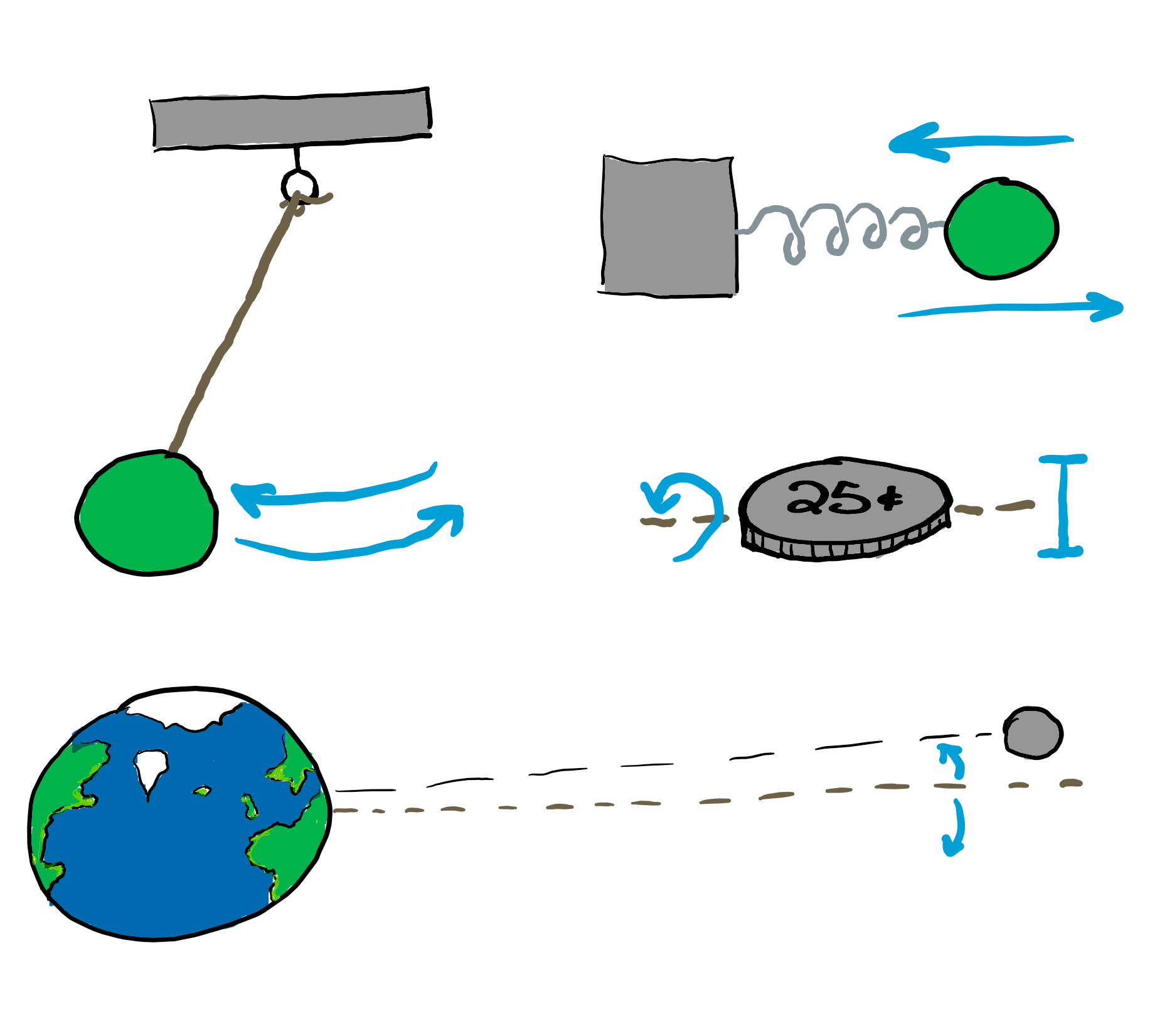
Here’s a simpler example: the motion of a weight on a spring, the swing of a pendulum, the profile of a spinning object, lunar declination, and countless other examples are all (approximately) described by sine waves. In some sense, the structure (the mathematics) is the same, even though the context can be wildly different.
It can even happen that mathematics is created with a particular context in mind, and then that context later turns out to be erroneous… but the structure—the mathematics—remains unfazed! For example, a lot of the early work done on knot theory was motivated by Lord Kelvin’s hypothesis that atoms are actually knots in the aether. If it were true, it would have provided a very interesting, classical explanation for why there are atoms of distinct types. But, of course, we now know that it was entirely false—not only are atoms not knots, but the luminiferous aether itself doesn’t even exist! And yet, knot theory survives with no alterations. As another example, there are a surprising number of results in pure mathematics that were intuited via string theory (the main but highly speculative attempt at a Theory of Everything in physics). It is entirely possible that we will eventually learn that string theory is completely wrong, and it will be consigned to the dustbin of history. But the results that were proved by reasoning as if it were true will remain valid!
In mathematics, context is a tool, to be used or discarded as needed. This makes mathematics a subject about nothing in particular, and therefore about everything generally. It makes it difficult to teach, but extremely powerful.
Understanding this helps to demystify mathematics. In 1959, physicist Eugene Wigner gave a talk (published a year later) titled The Unreasonable Effectiveness of Mathematics in the Natural Sciences. In it, Wigner argued that mathematics has been of central importance in building models in physics, chemistry, and biology, and that these models are much more effective than they have any right to be.
I believe it is well worth reading, but I actually disagree with its core thesis! I mean, yes, of course, mathematics has been central in the natural sciences, but I don’t think that it is at all surprising. There are two reasons why I say this.
The first is that, although he gives a wide set of examples, Wigner definitely cherry-picks. For instance, he didn’t include anything about modeling any kind of fluid: be that predicting the weather, studying turbulence, or understanding the sun’s heliosphere. And for good reason—all of those are still giving us trouble even in the present day! Once you accept that he cherry-picks, the argument becomes more properly represented as saying that mathematics is unreasonably effective at describing the things that we have found it to be effective at describing. This is nearly tautological.
The other part of this is that if you accept that mathematics is all about studying structure divorced from context, then it shouldn’t be remarkable that it is good at describing various systems. We’re just observing it and very carefully working out its behavior, whatever that happens to be. And if we are able to be precise enough that we can forget about the original system and just focus on the rules, then that is mathematics. If you were to believe that mathematics was all about numbers and equations, then, yes, it would be enormously surprising that it can describe so many different things! But that isn’t what it is about—it just happens to be one of (a vast multitude) of tools that mathematics offers.
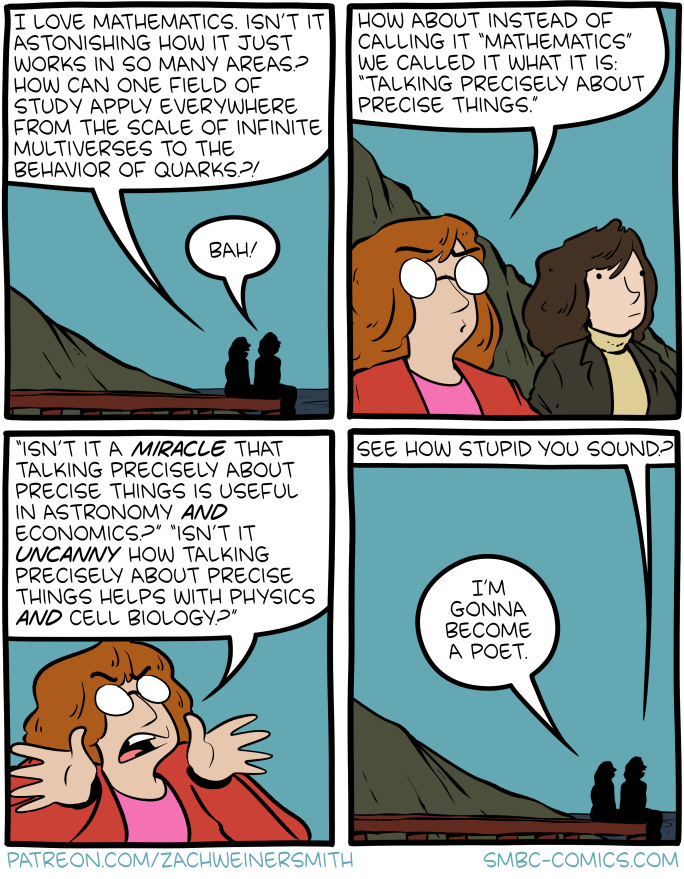
If you can describe a system precisely enough, that will be mathematics, regardless of whether it looks anything like what we conventionally think of as mathematics. (And mathematics already includes countless structures that are much weirder than anything the average layperson has seen or conceived of.)
Different studies give different numbers due to the different methodologies, but I don’t think anyone disputes that it is a serious problem.
A computer scientist acquaintance related the following story: he used to teach introductory computer science, and he would cover Boolean logic. This would proceed without much issue unless he referred to it as Boolean algebra—test scores would immediately dip! The material was exactly the same, but the perception was completely different.
«Once you accept that [Wigner] cherry-picks, the argument becomes more properly represented as saying that mathematics is unreasonably effective at describing the things that we have found it to be effective at describing.»—I wonder. Yes, Wigner does cherry-pick, but it's hard to cherry-pick his main example (i.e. fundamental physics). And he was writing in a time when we seemed to be approaching a Theory of Everything, and when the main components of that theory were suffice to say *extraordinarily beautiful*. Now, I don't think Wigner's address would be quite so convincing in a 21st-century context of stagnant physics and numerically-analyzed natural sciences, but if one puts that aside for the moment to consider the astonishing elegance of special relativity, general relativity, and quantum mechanics his argument makes a bit more sense, I think.
Excellent article. I think your definition of math is spot-on, as well as the explanation for why the "unreasonable effectiveness" isn't unreasonable. I was always baffled by the unreasonable effectiveness stuff because my immediate response was, "What do you mean? You can describe *any* system with math. You can define whatever mathematical structures you want to match the structure of the system." I think maybe what people actually mean is that they're surprised that many real-world systems can be described by mathematical structures simple enough that we can actually use them effectively to figure out what the systems will do. But then talking about math is a red herring - the question is just why these systems are simple enough to be intelligible. And even then, there's a fairly simple explanation from a combination of cherry-picking, the fact that systems actually are complicated but our models simplify them deliberately, and the fact that we evolved to be smart enough to comprehend a wide variety of real-world systems through abstraction.